

That slow drip, drip, drip at 2 a.m. is more than an annoyance. A faucet that keeps dripping after you've turned it off is telling you something inside has worn out, cracked, corroded, or stopped sealing the way it should.
So, what causes a leaky faucet? Most of the time it's a worn washer or O-ring, a corroded valve seat, or a tired cartridge. Less often, the culprit is high water pressure, a damaged outdoor spigot, or a worn diverter or valve in your tub or shower.
And the drip isn't harmless. According to the EPA's WaterSense program, a faucet leaking at one drip per second can waste more than 3,000 gallons of water a year. That's money and water going straight down the drain.
In this guide, we'll walk through each cause, what it looks like, and what you can realistically fix yourself versus when it's smarter to call a pro. Whether you're in Spicewood, Marble Falls, Burnet, or anywhere else in the Hill Country, here's how to track down the problem.
First, Figure Out Where Your Faucet Is Leaking
Where the water shows up usually points to the cause:
Dripping from the spout when the faucet is off: a worn washer, O-ring, valve seat, or cartridge
Water around the base of the handle: a worn O-ring or seal, or a loose packing nut
Water pooling at the base of the faucet or under the sink: a failing supply line, loose connection, or damaged seal
An outdoor spigot that leaks only while it's running: worn packing or a failing stem seal
A tub spout or showerhead that keeps dripping after shutoff: a faulty diverter or shower valve
Several fixtures acting up at once: a water pressure problem somewhere in the system.
Now let's look at each cause in more detail.
1. Worn Washers and O-Rings
Every time you turn a compression-style faucet on and off, a small rubber washer presses against the valve seat to stop the flow. Do that thousands of times and the rubber hardens, cracks, or flattens out. Once it can't press tight anymore, water slips past and you get that familiar drip from the spout.
O-rings are the small rubber rings that seal moving parts, like the stem under your handle. When one fails, you'll usually see water around the handle or base instead of the spout.
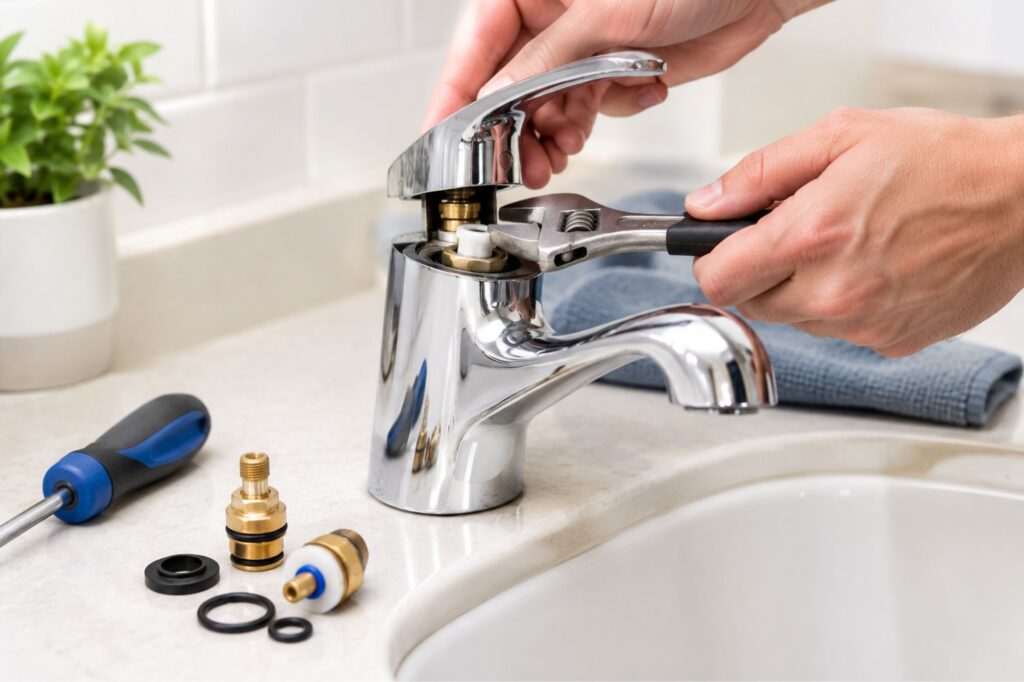
Can you fix it yourself? Often, yes. Shut off the supply valves under the sink, take the faucet apart (snap photos as you go), and swap in the new part. The tricky bit is matching the replacement exactly, because washers and O-rings come in dozens of sizes. Bring the old one with you to the hardware store. If the faucet still drips afterward, something else is going on, and that's a good moment to stop before you damage the fixture.
2. A Corroded Valve Seat
In many older faucets, the valve seat is the small brass fitting the washer presses against. When mineral deposits and corrosion roughen that surface, even a brand-new washer can't seal against it. The drip comes right back.
Hard water makes this more likely, and it's common across much of the Hill Country, so scale buildup shows up in local plumbing a lot. A big clue is a faucet that drips again soon after you replaced the washer.
Light buildup can sometimes be cleaned away. A badly corroded seat usually needs to be resurfaced or replaced. If scale keeps coming back, a water softener can protect your fixtures and appliances from the same problem.
One more thing worth knowing: the spot where you see water isn't always where the problem started. Water can travel along a fixture before it drips, which is why a quick professional look can save you a lot of guessing.
3. A Faulty Faucet Cartridge
So why do water heaters leak in the first place? A few usual suspects:
Most newer faucets use a cartridge (or a ceramic disc or ball assembly) instead of traditional washers. They're reliable and long-lasting, but they don't last forever.
Watch for these signs:
The faucet drips even when the handle is fully off
The handle feels loose, stiff, or gritty
The water temperature is harder to control than it used to be
Water leaks around the handle
Replacing a cartridge takes more than popping off the handle. The faucet has to be partly disassembled, and the new cartridge has to match your exact make and model. Install the wrong one, or put it back misaligned, and you can end up with a leak that's worse than the one you started with.
Not sure what brand of faucet you have? Our team handles faucet repair every day and can identify the right part. And if your faucet is old, corroded, or has been repaired more than once, a new faucet installation is sometimes the more sensible fix.
4. Damaged Outdoor Faucets
Your hose bib takes a beating: sun, dirt, temperature swings, and a garden hose tugging on it all summer. Where the leak appears tells you a lot:
1. Drips from the spout after it's shut off: usually a worn washer or seat
2. Leaks around the handle, but only when the water is on: typically worn packing or a loose packing nut
3. Water spraying from the cap-shaped vacuum breaker near the top while running: the vacuum breaker may be failing.
Freezing weather is another common cause. We don't get hard freezes often in the Hill Country, but when we do, water trapped inside an outdoor faucet expands and can crack fittings, sometimes inside the wall where you can't see it. Disconnect your hoses before a cold snap and read our tips on how to winterize your plumbing.
A small outdoor leak still wastes water and can keep the soil or siding near your foundation damp. Depending on the damage, the fix might be a new internal part, or the whole spigot may need replacing. Learn more about our outdoor plumbing services.
5. High Water Pressure
Home water pressure should typically sit somewhere around 40 to 60 psi. When it climbs much higher (above roughly 80 psi), every washer, seal, and cartridge in your home is under constant strain. They wear out faster, and you may notice drips popping up in more than one place.
Other signs of high pressure include banging or knocking pipes, toilets that run or refill on their own, and appliances that seem to wear out early. A simple pressure gauge that screws onto a hose bib can give you a quick reading.
Here's the important part: don't assume pressure is to blame just because one faucet drips. If it's only one fixture, a worn part is almost always the more direct answer. But if several fixtures are acting up, pressure becomes a much stronger suspect.
The usual fix is a pressure reducing valve (PRV). We install and repair them as part of our water line services. Replacing faucet parts without fixing the pressure behind them just means you'll be doing it all again soon.
6. Faulty Diverters and Shower Valves
A diverter is the part that sends water to either your tub spout or your showerhead. When it wears out, you might notice water dribbling from the tub spout while you shower, a weak shower stream, or a drip that never quite stops.
Shower valves have their own seals and cartridges, and when they deteriorate you can get a slow, steady leak from the showerhead even after you've turned everything off.
It's tempting to shrug off a light drip in the shower, but a lot of this plumbing lives behind the wall. Watch for stains on the ceiling below, a musty smell, or tile that feels loose or soft. Those are signs water is escaping where you can't see it. Our team handles shower repair and bathtub repair throughout the Hill Country.
DIY or Call a Plumber?
Plenty of homeowners can handle a simple washer swap or clean off some mineral buildup. If you want to try it, a few habits will save you headaches:
1. Turn off the supply valves under the sink (or the main shutoff for outdoor spigots) before you start
2. Plug the drain so small screws and parts don't disappear
3. Take photos as you disassemble, so you remember how it goes back together
4. Bring the old part with you to find an exact match.
It's time to call a professional if:
1. The faucet still leaks after you've replaced a part
2. Parts are stuck, stripped, or heavily corroded
3. You see water under the sink, around the base of the fixture, or inside the cabinet
4. The leak is in a shower or tub, or behind a wall
5. Multiple fixtures are leaking or acting strangely
Keep taking a fixture apart without knowing what's wrong and you risk making it worse. A technician can find the actual source, often with a full plumbing inspection and diagnosis, and fix it the right way the first time.
What Happens If You Ignore a Dripping Faucet?
Not every drip becomes a disaster. But a leak is an early warning that something is wearing out, and waiting rarely makes it cheaper. Over time, an ignored leak can lead to:
Wasted water and higher water bills
Corrosion that damages other plumbing parts
Moisture damage to cabinets, countertops, walls, or flooring
Mold or mildew where moisture lingers
A bigger, more expensive repair down the road
A quick fix now is almost always easier than a repair after the damage spreads. If you're dealing with a hidden or stubborn leak, our leak detection and repair team can track it down without tearing up more than necessary.
Frequently Asked Questions
How much water does a dripping faucet waste?
The EPA estimates that a faucet dripping once per second can waste more than 3,000 gallons a year. A faster drip, or a leak that runs steadily, wastes even more.
Why is my faucet still dripping after I changed the washer?
The most common reasons are a corroded valve seat, a washer that's the wrong size, or a different failed part, such as an O-ring or cartridge. A plumber can pinpoint which one.
Is a leaky faucet a plumbing emergency?
A slow drip usually isn't. But if water is spraying, pooling under a sink, running through a wall, or showing up on a ceiling, shut off the nearest supply valve and call right away. We offer 24/7 emergency plumbing.
Should I repair or replace a leaky faucet?
If the fixture is in good shape and the fix is a single part, repair makes sense. If it's old, heavily corroded, hard to find parts for, or has already been repaired several times, replacement often costs less in the long run.
Can hard water cause a faucet to leak?
Yes. Mineral buildup can interfere with seals and valve seats and speed up corrosion. If you see white, chalky deposits on your fixtures, hard water is likely part of the story.
The Bottom Line
So, what causes a leaky faucet? It could be a worn washer or O-ring, a corroded valve seat, a faulty cartridge, a damaged outdoor spigot, high water pressure, or a worn diverter or shower valve. Some of these are quick, inexpensive fixes. Others need a trained eye to find the real cause.
The good news is that nearly every faucet leak can be fixed once you know what's causing it. And you don't have to spend your weekend guessing which part to replace.
At Spicewood Plumbing, we're a local, family-owned team with more than 25 years of experience serving homes and businesses across Spicewood, Marble Falls, Burnet, Horseshoe Bay, Lakeway, and Bee Cave. Our technicians are fully licensed and insured, and we offer upfront pricing so you know what to expect before we start.
Got a faucet that won't quit dripping? Schedule your repair online or call us at (830) 999-HOME. We'll find the cause and get it fixed.